
Industrial safety is entering the data era
Over the past decade, the manufacturing industry has undergone a profound digital transformation. Production, maintenance, quality, and supply chain functions now rely on data and performance indicators to monitor operations, identify inefficiencies, and drive continuous improvement.
Occupational health and safety is following the same path.
The growing availability of sensors, monitoring systems, software platforms and advanced analytics now makes it possible to observe operational phenomena that, until only a few years ago, were extremely difficult to measure. This is not simply a technological evolution; it represents a new way of understanding, assessing and managing operational risk.
Rather than changing the fundamental principles of safety management, these technologies provide organizations with new tools to implement ISO 45001 more effectively.
New technologies create new opportunities for ISO 45001
Published in 2018, ISO 45001 introduced an occupational health and safety management model built around risk-based thinking and continual improvement.
The standard goes far beyond regulatory compliance or incident management. It requires organizations to establish processes capable of identifying hazards, assessing risks, monitoring and measuring OH&S performance, analysing results, and implementing continual improvement actions.
In other words, the key question is no longer simply: “Did we manage an incident correctly?” It becomes: “Are we able to understand how risk exposure evolves over time and demonstrate, through objective evidence, that our actions are actually improving safety performance?”
Today, this approach takes on an even broader meaning. The objective is no longer limited to analysing incidents after they occur, but also to identifying operational situations and weak signals with the potential to escalate into a
Serious Injury or Fatality (SIF). Detecting these conditions early is becoming one of the most important aspects of modern prevention, allowing organizations to intervene before risk turns into a severe event.
The principles of ISO 45001 remain fully relevant. What has changed is the ability to collect objective evidence that supports them.
From risk-based thinking to continuous risk observation
One of the core principles of ISO 45001 is integrating risk management into organizational decision-making. Risk assessments, audits, workplace inspections, incident investigations, behavioural observations and near-miss management remain essential components of every occupational health and safety management system.
Operational risk, however, is inherently dynamic.
- Production layouts change.
- Internal logistics evolve.
- New vehicles and equipment are introduced.
- Production volumes increase.
- People continuously adapt their behaviour to real operating conditions.
A risk assessment therefore represents a snapshot of a constantly changing environment.
Today, monitoring technologies and operational data collection make it possible to complement traditional methodologies—which often include a significant subjective component—with continuous observation based on objective, measurable and comparable information.
This does not replace the expertise or professional judgement of HSE managers. Instead, it strengthens their decision-making by providing quantitative evidence that helps understand how risk exposure evolves between one assessment and the next.
The real value of data is measuring improvement
Continual improvement is one of the fundamental principles of ISO 45001. But improvement can only exist if it can be measured. When an organization redesigns a facility layout, introduces a new procedure, separates pedestrian and vehicle routes, updates safety signage or implements additional preventive measures, the key question should not simply be whether the action has been completed. The real question is: has the intervention actually reduced risk exposure?
Traditionally, organizations answer this through workplace observations and, over time, the absence of incidents. These remain essential indicators, but they can now be complemented by data-driven information capable of making the effectiveness of preventive measures far more measurable.
Data does not replace the judgement of HSE professionals. It reinforces it. It becomes another decision-support tool, helping transform continual improvement from a guiding principle into a measurable process.
AME’s contribution: turning operational events into actionable insights
Within our area of expertise, we focus on a specific aspect of industrial safety: managing interactions between pedestrians and industrial vehicles inside manufacturing plants and warehouses.
Although this represents only one component of industrial safety, internal traffic management is a highly dynamic operational environment where workers are continuously exposed to potential risk situations. In this context, objective operational data can make a significant contribution to prevention strategies and continual improvement.
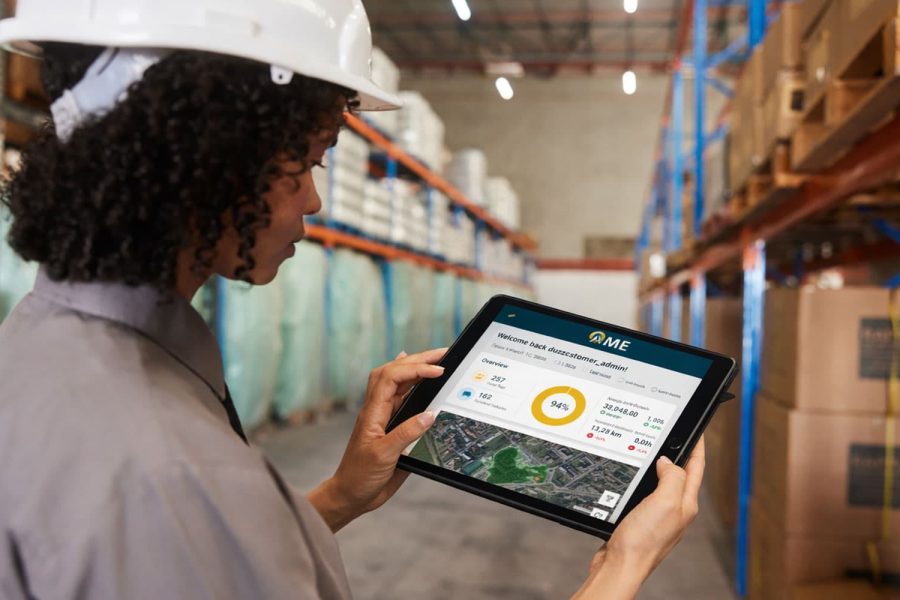
Through AMESPHERE Platform, AME collects and analyses operational events generated in the field, transforming near misses, pedestrian-vehicle interactions, proximity events, operational hotspots and other observable phenomena into structured information that can be monitored and compared over time. The platform provides dashboards, KPIs, historical trends and automated reports that enable organizations to:
- measure and monitor operational risk using objective data;
- identify recurring behaviours and risk patterns;
- compare safety performance across different areas or facilities;
- support audits, management reviews and decision-making with readily available evidence;
- verify the effectiveness of corrective actions over time.
The objective is not to generate more reports. It is to provide HSE managers with meaningful insights that help them understand where risk is concentrated, how it evolves over time, and which interventions produce measurable improvements

Conclusion
Digital transformation does not change the principles of ISO 45001. It expands the way those principles can be applied.
Today, the expertise of HSE professionals, a strong safety culture and established management systems can all be supported by objective information that enables organizations to monitor safety performance with a level of continuity and detail that was previously difficult to achieve.
The real challenge is not collecting more data. It is transforming data into meaningful insights that support better decisions. Because the true value of Data-Driven Safety is not increasing the number of KPIs—it is demonstrating, through objective evidence, that the continual improvement required by ISO 45001 is genuinely taking place.
Download the full article: