
In a $10 trillion industry, protecting people is becoming a structural driver of competitiveness.
In a $10 trillion industry, protecting people is becoming a structural driver of competitiveness. The Food & Beverage sector continues to be one of the most dynamic industrial segments globally, driven by population growth, evolving consumption patterns, and the progressive digitalization of production supply chains. According to recent market estimates, the global food and beverage industry exceeds $10 trillion in value, with steady annual growth projected over the next decade, fueled by automation, intelligent logistics, and the digital transformation of global operations.
At the European level, the report “The EU food and drink industry: a competitiveness analysis” highlights that the food and beverage supply chain represents the largest manufacturing sector in the European Union, with over 300,000 companies and approximately 4.7 million direct employees — accounting for around 15.7% of total EU manufacturing employment. Overall, the sector generates approximately €200 billion in added value, making a significant contribution to the European economy and supporting an additional one million indirect jobs across agriculture and distribution.
The industry’s trade performance is equally relevant: the European Union (EU27) recorded an extra-EU trade surplus of approximately €81 billion, with exports exceeding €183 billion in 2023 to non-EU markets, including the United States, China, and Switzerland.
Italy also demonstrates strong performance and resilience in the sector. According to the latest data, the Italian food industry ranks among the country’s most significant manufacturing segments: with total revenues of approximately €193 billion, it represents more than 15% of the total added value of the national manufacturing industry, comprising over 60,000 companies and nearly 464,000 employees.
Within this growth and competitiveness context, increasing attention to social sustainability and production efficiency is leading many Food & Beverage companies to treat operational safety as a structural component of industrial management. However, economic expansion and technological advancement do not eliminate operational risks in the workplace, making stronger prevention and control strategies essential within production facilities.
Workplace safety data confirms the central role of safety in production and logistics flows.
Within this growth and competitiveness context, increasing attention to social sustainability and production efficiency is leading many Food & Beverage companies to treat operational safety as a structural component of industrial management. However, economic expansion and technological advancement do not eliminate operational risks in the workplace, making stronger prevention and control strategies essential within production facilities. Production activities — and particularly material handling in industrial environments — represent a critical safety domain within the Food & Beverage sector.
Data published by INAIL indicate that the food manufacturing sector records a significant number of workplace injury reports annually, while the beverage industry reports lower but still noteworthy figures.
Regarding the most severe incidents — those resulting in fatalities — the food sector ranks second among industrial segments in terms of fatal workplace injury reports (the highest number of fatal cases is recorded in the fabricated metal products manufacturing sector).

These statistics reinforce the urgency of raising safety and control standards within production and logistics flows in the Food & Beverage industry — both to protect workers and to ensure operational continuity.
In modern facilities characterized by increasing operational density, it is no longer sufficient to rely exclusively on passive safety measures. Instead, companies must adopt proactive protection systems capable of anticipating risk conditions and intervening in real time.
People safety is a core component of corporate social sustainability, safeguarding human capital while ensuring production continuity, operational stability, and overall plant resilience.
From risk detection to predictive management: the digital ecosystem for operational safety
For over twenty-five years, AME has been developing technological solutions to enhance people safety and operational efficiency in complex industrial environments, with applications ranging from intralogistics to advanced manufacturing.
The company’s approach is based on the Active Safety principle — a safety model that does not merely react to incidents but intervenes before a risk situation escalates into an accident.

At the heart of this paradigm is the AMESPHERE digital ecosystem, an integrated solution combining AIoT technologies, hardware devices, and software platforms to enable continuous communication between sensors, field devices, and data analytics systems.
Through Local Positioning Systems (LPS), artificial intelligence, and advanced signal-processing algorithms, the system monitors in real time the interaction between operators and industrial vehicles such as forklifts and AGVs.
A distinctive feature of AMESPHERE is its ability not only to detect positioning but also to evaluate the quality of interaction and the associated risk level of each event. This selective intervention model reduces redundant alarms while preserving operational continuity and efficiency.
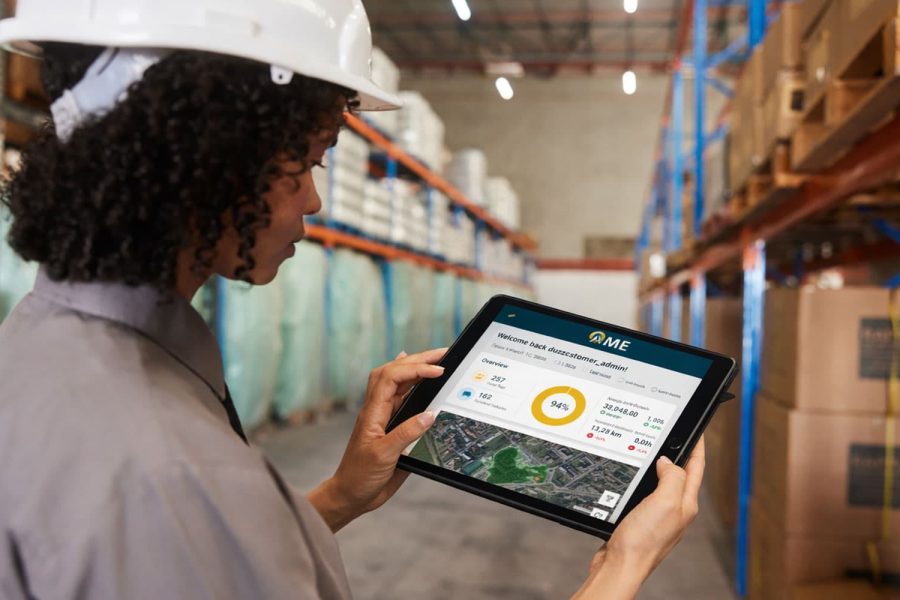
Data collected by field-installed sensors are transmitted and stored in the cloud and processed by the AMESPHERE Platform software, making information accessible via intuitive dashboards and instant notification systems. The solution generates analytical reports on operational safety, material handling efficiency, and fleet management, providing HSE managers and plant managers with objective indicators to support evidence-based decision-making.

AMESPHERE: The data-driven solution for operational safety in the Food & Beverage industry
AME’s solutions have been implemented in several international Food & Beverage production environments, supporting global companies in managing operational safety across logistics and industrial processes.
In facilities belonging to major industrial groups, AMESPHERE has been integrated into internal handling systems to enhance safety in warehousing and handling areas, where the simultaneous presence of workers and industrial vehicles represents a primary operational risk factor.
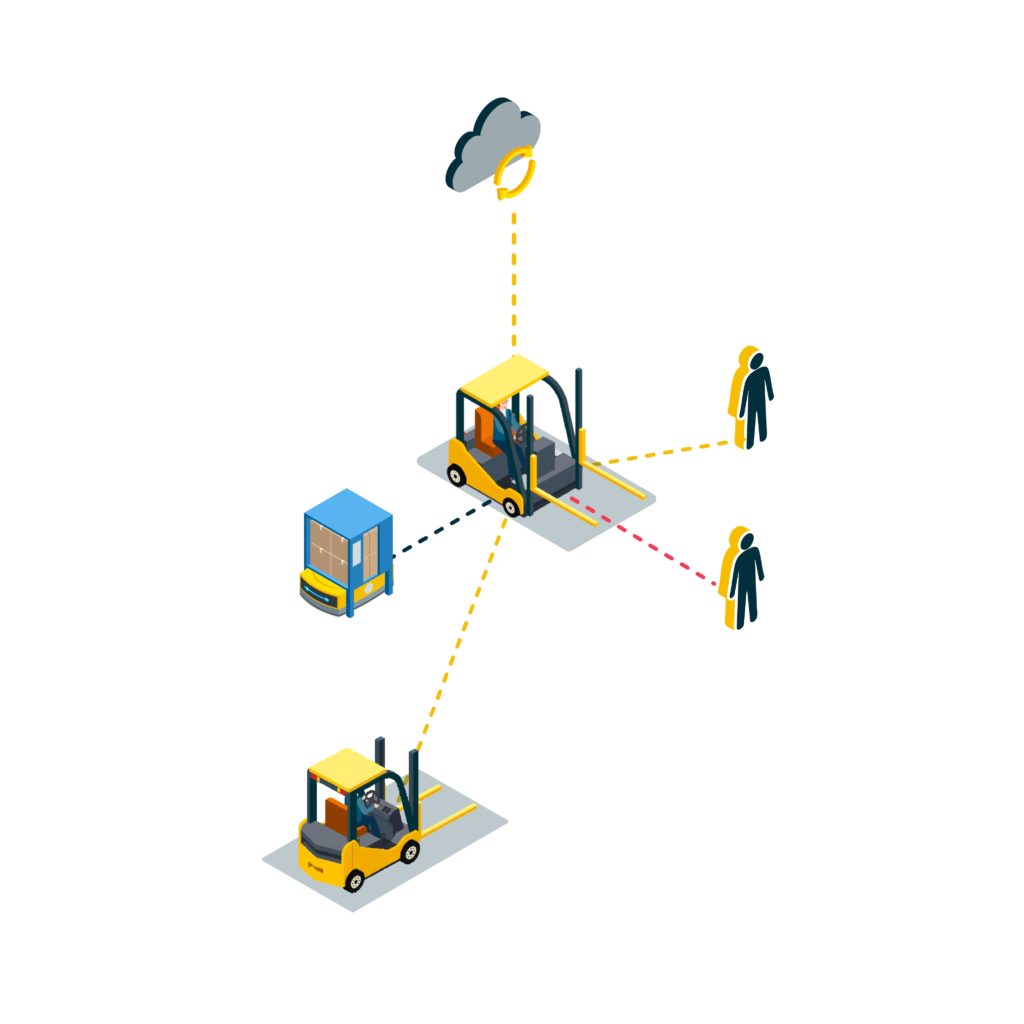


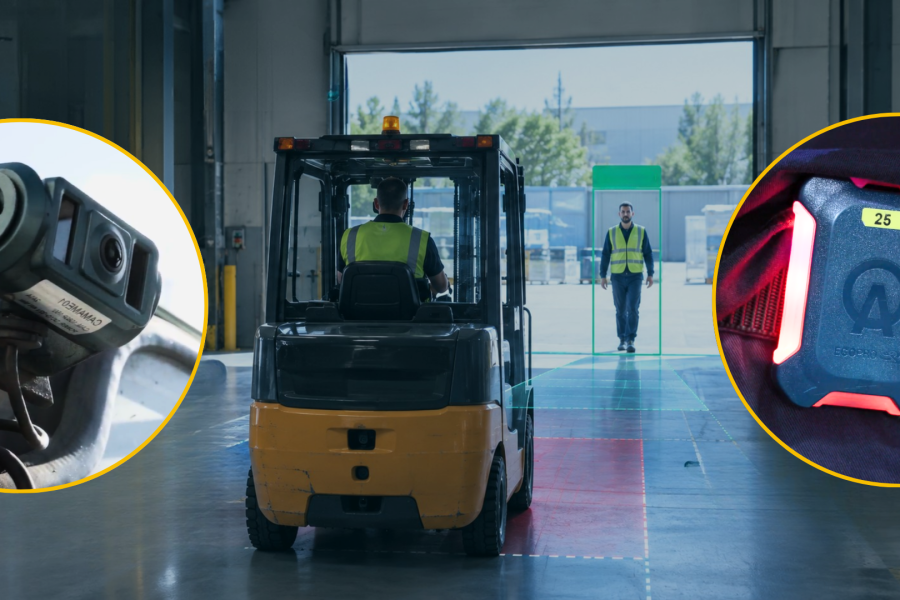
The anti-collision system is one of the core components of the AMESPHERE ecosystem. By integrating active TAGs, LPS sensors, AI-powered cameras, and on-board vehicle devices, the system detects in real time the presence of operators, forklifts, AGVs, or other machinery within the same operational area. When a risk condition is identified, the system activates acoustic and visual alerts, automatically modulates vehicle speed, or generates instant notifications — intervening selectively only when necessary to ensure both safety and operational continuity.
Smart internal traffic management enables control over facility movement through configurable virtual “safe areas” tailored to the production layout. Logistics intersections, pedestrian crossings, loading and unloading bays, and low-visibility zones can be automatically monitored and regulated. Industrial vehicles can adapt their operational behavior — for example by automatically reducing speed within controlled areas, lowering forklift forks, or applying other configurable functional profiles.
Special attention is also given to contractors, technicians, and visitors who may not be fully familiar with the facility’s safety procedures. The assignment of active TAGs makes them immediately identifiable within the control system, allowing handling vehicles to adjust speed or trigger alerts in the presence of potential risk situations.
The benefits of a data -driven safety model
The adoption of integrated technological solutions enables Food & Beverage companies to address industrial safety with a more advanced and strategic approach. Key benefits include :
– a reduction in the risk of human – machine collisions
– improved quality of operational data
– enhanced decision -making supported by measurable and objective indicators.
Ease of integration into production processes, combined with continuous monitoring and cloud -based data analytics, transforms safety from a regulatory obligation into a driver of organizational improvement.
Conclusion : safety as a driver of industrial competitiveness, not merely regulatory compliance
In a sector characterized by increasing automation, high logistics intensity, and stringent quality standards, industrial safety cannot be regarded solely as a compliance requirement. It must be recognized as a central element of operational sustainability and corporate competitiveness.
The solutions developed by AME represent an evolution in protection paradigms for complex production environments, where risk prevention is integrated with process optimization and operational data analytics.
Through Active Safety methodologies, AIoT technologies, and the transformation of field data into actionable knowledge, safety becomes an enabler of production continuity and operational excellence.
Investing in intelligent safety models therefore means protecting people, supporting industrial processes, and building more resilient production ecosystems — where technology and organizational strategy work together to mitigate real workplace risks and strengthen long-term competitiveness.