
In industrial and logistics environments, the coexistence of workers and heavy vehicles creates complex risk scenarios every single day. The movement of forklifts, lift trucks, AGVs and overhead cranes in often confined spaces with limited visibility is one of the main challenges for workplace safety. The consequences of a collision can range from significant material damage to serious injury, with a direct impact on operational continuity and staff wellbeing. This is why safety management has moved from a reactive approach to a proactive strategy that aims to eliminate risk at source through the implementation of advanced anti-collision systems. Anti-collision systems represent a fundamental step forward in industrial and logistics safety, shifting risk management from reactive to proactive. Based on advanced technologies such as IoT, AIoT and UWB sensing, these systems constantly monitor the operating environment to prevent collisions between vehicles and workers, especially in complex settings such as high-density warehouses or sites with blind spots. By combining data and artificial intelligence, they deliver real-time operational visibility and decision support that not only protects people, but also optimises efficiency and business continuity.
Introduction: From Operational Complexity to Proactive Safety
The industrial and logistics sector is inherently characterised by complex operational dynamics. Large machinery, industrial vehicles and numerous workers move simultaneously in spaces that can be crowded, noisy and subject to environmental variation. This complexity, combined with the need to maintain high productivity standards, constantly exposes staff to concrete risks of accidents — collisions in particular. Poor visibility, blind spots and distractions all contribute to creating dangerous situations, with potential interruptions to production processes and, more seriously still, severe harm to people. Developments in this field call for a change of paradigm: no longer regulatory compliance alone, but proactive and intelligent safety management that anticipates and neutralises threats before they materialise. Predictive anti-collision safety solutions, for example, are becoming crucial in preventing accidents.
Context and Critical Issues: Accidents and Collisions in the Workplace
In production plants, high-density warehouses and construction sites, the movement of operating vehicles such as forklifts, lift trucks and overhead cranes is a constant. The coexistence of these vehicles with workers on foot creates a dynamic environment in which the risk of collision is ever present — a challenge that the modern digitalisation of construction sites and industrial plants aims to resolve. Accidents caused by poor visibility frequently occur in these environments: for example, blind-spot collisions between forklifts and workers in high-density warehouses. This is a reality that is rarely discussed, but which we observe daily in our projects, where traditional systems often fail to provide adequate protection. A common mistake is to underestimate the economic impact of such incidents, which goes well beyond the mere cost of repairs. A single overhead crane impact, for instance, can mean tens of thousands of euros in structural repairs and unplanned machine downtime. A data-driven approach to industrial safety and operational risk therefore becomes essential in preventing these critical scenarios. And this is without counting the indirect costs linked to lost productivity, insurance and the deterioration of staff morale. The hidden challenge is in fact managing harsh environments where dust, smoke or vapour block optical or laser sensors, rendering many standard solutions ineffective. Anyone working in this sector knows that only robust technologies such as radar or ultrasound can guarantee reliability in these conditions.
Limits of Traditional Approaches to Safety
Traditional approaches to safety, often based on manual checks, static signage and periodic training, now show clear limitations. While necessary, these measures are not always sufficient to manage the complexity and dynamism of modern operating environments. Fragmented information management, the lack of real-time visibility of human-machine interactions and reactive approaches — which only come into play after an accident has occurred — leave considerable room for risk. A typical problem is excessive reliance on human perception, which can fail under stress or distraction. It is a common mistake to assume that workers’ attention alone is enough to prevent every accident. This is why the need for greater operational visibility and for active prevention tools has become pressing. Traditional systems, in fact, cannot effectively mitigate problems such as signal bounce in environments with physical obstacles like pillars or machinery, where advanced technologies such as UWB (Ultra WideBand) instead offer accuracy down to 10 cm — a technical detail that only those working in the sector fully appreciate. To address these challenges, AME has developed AMESPHERE, the innovative new “Safety as a Service” standard.
The Proactive Approach: The Role of the Intelligent Anti-Collision System
Adopting an intelligent anti-collision system is a fundamental step towards proactive safety management.
These systems do more than simply flag a hazard: they constantly monitor the operating environment, collect data on interactions and intervene actively to prevent accidents. The goal is to transform safety from a regulatory obligation into a process that is measurable, monitorable and improvable over time. The operational value of these technologies is tangible: they deliver active prevention, decision support based on objective data, real-time operational visibility and constant risk control. Anti-collision systems for forklifts and AGVs, for example, detect interactions between vehicles and workers in real time, assess the level of risk and intervene automatically with visual and audible alerts, and even with automatic vehicle slowdown. This approach drastically reduces the likelihood of collisions and accidents, protecting not only staff but also assets, while safeguarding operational continuity. Flexibility is a key feature: as AME puts it, the platform’s main characteristic is its flexibility, which allows the system to adapt to any type of environment.
Technological Innovation: IoT, AIoT and Sensors for Prevention
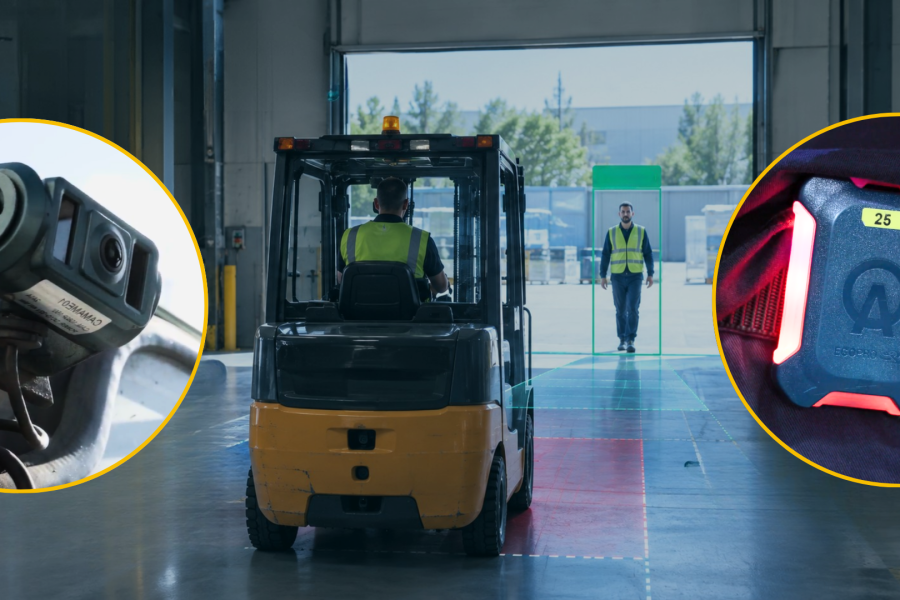
The evolution of anti-collision systems is closely tied to technological innovation, and in particular to the integration of IoT (Internet of Things), AIoT (Artificial Intelligence of Things) and advanced sensing. These technologies make it possible to collect and analyse a vast amount of data, turning it into strategic safety information. UWB (Ultra WideBand) sensors, for example, are used in anti-collision systems for forklifts, offering detection accuracy down to 10 cm — a crucial figure in complex environments with physical obstacles. Implementing advanced industrial safety systems requires specialist expertise and cutting-edge technology in order to guarantee maximum operational effectiveness, especially when it comes to protecting workers operating near dangerous machinery. These systems not only detect proximity: they can also define “exclusion zones” — areas where vehicles must not pass because of the presence of offices or delicate machinery — optimising routes and protecting sensitive assets. Another example of innovation is the use of integrated AI Camera + TAG systems, such as those developed by AME, which prevent collisions even in blind spots where radar and traditional optical sensors fail. These systems are essential in settings where visibility is compromised. Safety and collision avoidance are no longer just a matter of detection, but of analysis and automated intervention. The experience AME has built up in active safety on complex projects demonstrates how advanced technologies can deliver protection even in the most challenging environments.
Frequently Asked Questions
What is an anti-collision system?
An anti-collision system is a technology designed to prevent accidents between industrial vehicles (such as forklifts, lift trucks and AGVs) and workers on foot, or between the vehicles themselves, in complex operating environments. It uses sensors and algorithms to detect proximity and risk, triggering alarms or automatic interventions. AME also presented its innovations at SafetyWorx 2026, introducing new KPIs for workplace safety.
How do anti-collision systems work?
Anti-collision systems work through a combination of sensors (UWB, AI Camera, ultrasound) that constantly monitor the environment. They detect the position and speed of vehicles and people, assess the risk of collision and trigger visual and audible alarms, or automatically slow down or stop vehicles to avoid impact. For in-depth data analysis, AMESPHERE — AME’s cloud software platform — provides the necessary tools.
What are the benefits of anti-collision systems?
The main benefits include fewer accidents and reduced risk exposure, protection of staff and assets, improved operational continuity and process efficiency, and the provision of objective data for continuous safety analysis and improvement. They also help reduce the costs arising from machine downtime and repairs.
Why do they matter in modern warehouses?
In modern warehouses — characterised by a high density of vehicles and personnel, rapid handling operations and often limited visibility (blind spots) — anti-collision systems are essential for preventing accidents. They improve worker safety and protect stored goods, ensuring smoother, safer workflows in a dynamic environment.
What are forklift blind spots and how can they be avoided?
Forklift blind spots are areas the driver cannot see because of the structure of the vehicle, the load being carried or the layout of the environment. They can be effectively addressed with advanced anti-collision systems combining AI Camera and TAG technology, which detect the presence of people or obstacles even where human vision or traditional sensors fall short.