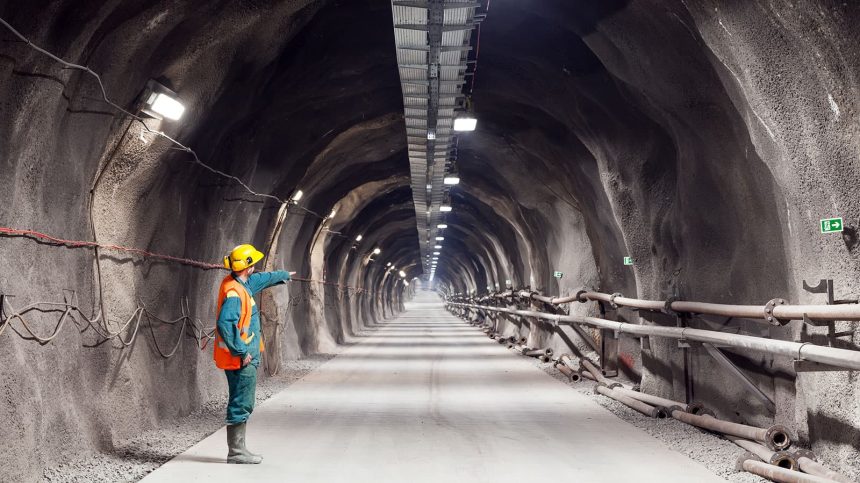
Working in a tunnel concentrates some of the most critical conditions for operational safety into just a few metres. Spaces are confined, visibility is reduced, lighting is artificial, and machinery advances along the face while workers move on foot through the same areas. Add to this dust, noise and the difficulty of communicating with the outside world. In a setting like this, knowing where people are at any given moment is not an organisational detail: it is the foundation on which accident prevention and emergency management rest.
Tunnel safety therefore calls for a change of approach, moving from periodic checks to continuous monitoring of the movement of people and vehicles. This is where real-time tracking becomes the central tool.
The Critical Issues in Tunnel Safety
The dynamics of an underground site are inherently complex and change as work progresses. The greatest risk arises from the coexistence of large vehicles — carrying out manoeuvres in tight spaces and in reverse — with workers on foot, often in conditions of poor visibility.
Other factors compound this basic risk. The presence of gas and air quality require constant attention. Escape routes are limited and can change as the face advances. Communication, essential in an emergency, is made difficult by the very shape of the tunnel. Every event — the outbreak of a fire, flooding, a medical emergency, an accident involving a vehicle — must be manageable in the knowledge of exactly who is present and in which section.
Real-Time Worker Tracking
Worker tracking answers precisely this need: knowing in real time where people are along the tunnel. Each worker wears a tag; a network of devices installed along the length of the works detects their presence and position, producing an up-to-date map of who is where.
The resulting information has immediate operational value. It makes it possible to verify that no one is entering a restricted or dangerous area, to check the density of people in the various sections and, if necessary, to reconstruct movements that have taken place. Worker tracking in tunnels turns information often handled verbally or on paper into objective data that is always available.
Managing Emergencies and Evacuations
It is in emergency management that tracking shows its most concrete contribution. When an alarm is raised, the first question is always the same: how many people are inside, and where are they? Having that answer in real time speeds up decisions, directs rescue teams and makes it possible to verify that an evacuation has actually been completed.
Emergency call systems distributed along the tunnel provide further support — such as SOS and emergency stations, which allow anyone in difficulty to report their situation and position without delay. Tracking and alarms together then feed into event management: every alert is recorded, associated with a position and handled according to a defined procedure, with no loss of information at the moments when it matters most.
Technologies and Data Integration
The value of these systems lies not in any individual device, but in how they are integrated. Tracking, alarms, environmental detection and communications all produce data that, left in isolation, offers only a partial view. Correlated with one another, however, they give a complete picture of the state of the tunnel.
That is the job of a safety intelligence platform. The AMESPHERE platform gathers this data, relates it and returns it — through a control room and dedicated dashboards — as usable information: who is present, where, which areas are most critical, how the situation is evolving. In this way tunnel safety ceases to be a collection of separate devices and becomes a coherent monitoring system, capable of supporting decisions in real time.
Conclusions
Tunnel safety depends on the ability to know, moment by moment, what is happening along the works. Worker tracking is the starting point: it makes the presence of people objective, strengthens prevention and transforms emergency management from improvised reaction into a data-driven procedure. Integrated with alarms, communications and environmental monitoring, it becomes the foundation of an active safety approach that protects people without slowing progress.
Frequently Asked Questions
Why is it important to track workers in tunnels?
Because in a confined space with reduced visibility and limited escape routes, knowing where people are in real time is essential for preventing accidents, avoiding entry into hazardous areas and managing emergencies and evacuations effectively.
How does worker tracking work?
Each worker wears a tag; a network of devices distributed along the tunnel detects their position and presence, producing an up-to-date map in real time. The data flows into a control room that makes it readable and usable.
How does tracking help during an emergency?
It makes it possible to know immediately how many people are present and where they are, to direct rescue teams, to manage SOS alerts and to verify that an evacuation has been completed, reducing both delays and uncertainty.